Privacy Policy
Cookie Policy
Legal Notice
ROBERTA SERENARI - Italy
CONTACT: info@robertaserenari.com
PERSONAL WEBSITE www.robertaserenari.com.
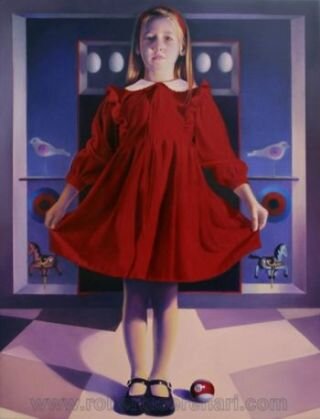
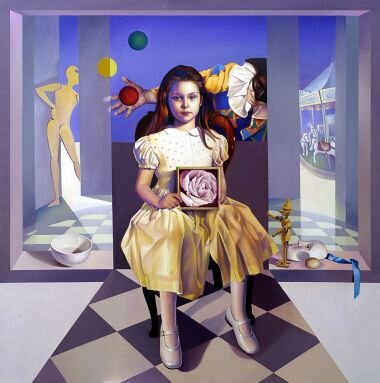
The invitation
The target
oil on canvas cm 140 x 140
oil on canvas cm 100 x 130
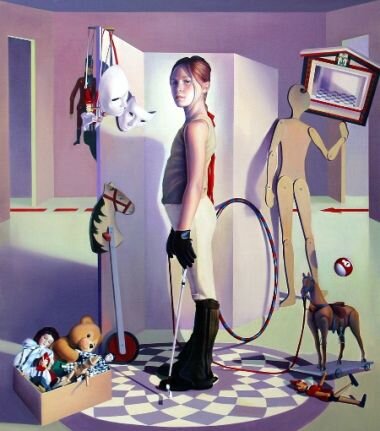
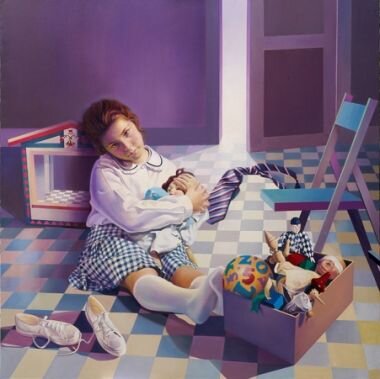
Dear Dad
The tamer
oil on canvas cm 140 x 140
oil on canvas cm 150 x 170
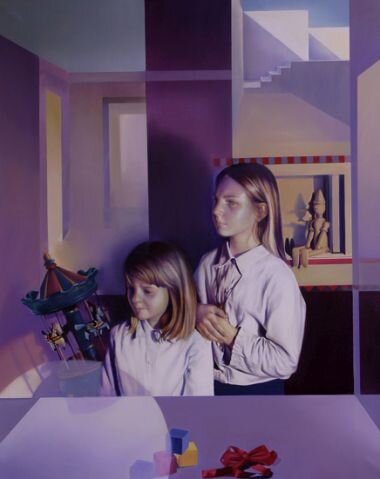
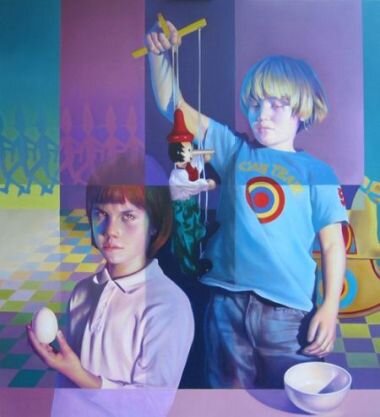
The eternal lie
Listening to the spell
oil on canvas cm 120 x 130
oil on canvas cm 120 x 130
Her Biography
born in Bologna and lives and works in Sasso Marconi (BO)
She is self-taught.
The natural gift for drawing in childhood was enriched over the years by an in-depth study of oil painting and art history, having as her only teacher the attentive and passionate gaze for works of the past and present seen in museums and galleries around the world.
Her painting has the vocation of leading to an intimate reflection, where a female presence endowed with a mysterious fascination prevails. The protagonists are often beautiful girls with austere and cold gazes, suspended between metaphysical scenarios and symbolic references that lead us to the search for the surprising mystery of the “passage”, of fleeting time, of the sense of waiting and of the feared change.
The titles of her solo exhibitions over the years reflect this favorite theme. They are in fact: “In Search of Alice”, “Breakfast”, “Dear Dad”, “I Killed Snow White”, “Intimate Theater”, “In Many Rooms”, “Rosa-Rosae”, “Ma-Donne”, “Enchantment and Spell”, etc…
She has participated in numerous group and solo exhibitions from 1982 to today, including in the 2000s at the Ariete and Forni galleries in Bologna, at Leudo in Genoa and Davico in Turin. This was followed by exhibitions in institutional venues such as Rocca Paolina in Perugia, Palazzo dei Pio in Carpi, Pirelli Skyscraper in Milan, Palazzo Albertini in Forlì, Palazzo Durini in Milan, Orsini Castle in Soriano Cimino (VT), Palazzo Bottini in Lucca, S.Leo Fortress in Rimini, Palazzo Zanca in Messina, Palazzo Valmarana Braga in Vicenza, Diocesan Museum in Catania, Monumental Complex S.Leucio Caserta, Bargellini Museum Pieve di Cento Ferrara, Fortezza Vecchia in Livorno, etc.
In 2011 she was invited by Vittorio Sgarbi to participate in the 54th Venice Biennale for the Italy Pavilion, Emilia Romagna section at Palazzo Pigorini in Parma with the work “Luna Park”.
Her works can be found in private and public collections such as the Cà La Ghironda Museum (BO), the Logudoro Museum (SS), the Picture Gallery of the Arcispedale Sant’Anna in Ferrara, the collection of the Albornoz Hotel in Spoleto and the Permanent Collection of Costa Crociere on the Costa Deliziosa and Costa Fascinosa ships.
They have written about her painting
….the context in which Serenari operates and creates can be interpreted as the objective realization of an intimate and romantic impulse, and yet the unmistakable mark of an ideality connected to plastic values that are intrinsic to figuration remains admirable, and which is situated well beyond the simple will to set up a recognizable and representative vision.
In this meditative painting, intense narrative backgrounds open up, where a female presence endowed with a mysterious fascination prevails.
Each of her compositions is arranged in an anti-rhetorical relationship with reality, which is proposed in a deliberately static key, as if produced by a visual appropriation defined in a frozen temporality.
Master of a pictorial stroke of undoubted qualitative level, she loves to analyze in full light the most disparate forms of a concrete but incongruous world, populated by emanations of dreams and memories of the adolescent female character who inhabits it, and who has now learned to dominate reality.
The Alice who lives in these paintings is perhaps still that of Lewis Carroll, since from the memory of her distant childhood journey remains the taste for reinterpreting space in imaginative perspectives of suspended and even metaphysical atmospheres.
But it is also evident that this is an Alice who has now grown up, well able to distinguish and choose the right side of the mirror.
Vittorio Sgarbi (excerpt from a longer text)
In the wonderland that Roberta Serenari creates, with a capacity for color and volumes that do not disregard technique nor feeling or passion, the intriguing mystery of dreamlike atmospheres stirs within cold freezing breezes capable of marbleizing the unaware girls dressed in that perfectly draped, soft red velvet, palpable, as if alive between our fingers.
Perfect faces exude a sharp emotional tension, express a communicative violence, transmitting it energetically without disappointing the expectations of the viewer.
The artist transposes the observer into the represented character, using a romantic calm and a dynamism concealed through slow-motion actions, performing a formal, almost theatrical rigor whose masks veil suspended or hidden gazes, leaving the viewer hanging, teetering in a reality undecided between the imaginary and the dream.
The architecture is multidirectional: it confuses, diffusing and gathering, making the scene explode as if opening onto a new, futuristic stage.
These are the secret labyrinths of Roberta Serenari’s art, a new art full of mysticism and magic, fascinating, dazzling, promising the expression of what we would like to see more often in art: evocative beauty and rigorous techniques.
The woman, in her works, whether girl or nymph, becomes the spokesperson for hidden meanings capable of opening a narrative on disturbing themes, which sometimes compromise innocence and candor within the female, childlike universe.
Roberta Serenari defeats all the darkest darknesses using the best weapon that can be wielded through art: Beauty.
it is in fact through this continuous search that the artist manages to legitimize the deepening of the emotional sphere as indeed emerges from what
she herself says:
“In my “Magic Realism”, through recurring symbolism and wordplay, I would like to give my figures the power to play a role with the viewer … The girls I represent are not anecdotal,
in their silence and stillness they do not tell, but ask…
They have a conscious and perhaps unsettling air because they are dressed in enormous power: everything has yet to happen…
They come from a place that crosses time,
leaving on the canvas the small magic of themselves.”
Carla Primiceri
Roberta Serenari approached painting as a self-taught artist, spending hours in museums and then alone, in the studio, working in oil on canvas.
Over the years she has achieved the very clean technique that now distinguishes her work.
The subjects move in metaphysical scenographies crowded with objects full of mysterious meanings, from the blindfolded doll abandoned in a box to the egg of fifteenth-century suggestion.
Even the colors, from the blood red of the little dresses to the white declined in drapery as sharp as blades, appear imbued with symbolic values, while the recurring chessboards and stripes suggest esoteric symbolism.
The protagonists are girls, always caught in that ineffable moment that separates childhood from adolescence.
Proud, prisoners of their crystalline perfection, they look at the viewer challenging him to penetrate their secret…..
Alessandra Radaelli
….mute and immobile presences like icons, are the little girls painted by Roberta Serenari, who for years has perfected this precious style of hers, rich in technical virtuosity, aimed at presenting an epiphanic childhood universe, an iconography of adolescence that is disturbing and rich in symbols, which seems to enclose the sense of the mystery of life.
Metaphysical and surreal little girls, hieratic as profane idols, while the objects that surround them, in precarious balance, reflect a blocked dynamism, a flash, an image snatched in the blink of an eye.
To the breakfast cups, Serenari’s superb painting by glazes brings a unique form like the egg, a closed and perfect microcosm that lives on autonomous solicitations, of enclosed and collected hopes, of geometric and artistic allusions (the egg of Piero Della Francesca).
These austere little girls, with a red ribbon in their hair and an enigmatic expression, are immersed in the virginal age of games, they enclose within themselves the feminine and masculine side, represented by the ties that appear with studied nonchalance among the objective references: the paper dolls, the ball, the carousel, the puppets, the candies, the female mannequin, idea of a body to come: a playroom that looks at the dream of life, at the unconscious project, at innocence still intact, visions of a fairy tale both modern and ancient at the same time…
Silvia Arfelli
The painting of Roberta Serenari, so refined and mimetic, where a kind of magic realism mixes with some surrealist option, has always posed some problems for me, not only aesthetic, which I do not hesitate to define as crucial.
When Sigmund Freud wrote his essay on Jensen’s Gradiva, he entrusted to literature, and we can well say to art in general, a new function: not only that of showing the dialectic of History, as Marxist thought wanted, or of making beauty concrete, as the devotees of art for art’s sake claimed, but of turning into a scientific probe, a metaphorical bathyscaphe to explore the depths of the unconscious.
The work of art, in short, became a virtual test to meet those mythical beings, the definition is from the last Freud, that are the instincts.
Serenari’s girls, so ambiguous and amazed, so deceitful and falsely innocent, are in line with Freud’s lesson, of his polymorphous monster child, the bad savage of the civilized adult, and thus diverge from that rediscovery of childhood as an Edenic place, that the painters of the just past century, think of Paul Klee, had fantasized about.
Thus, at the beginning of the twentieth century, two points of view clash, on the one hand that of childhood as an incubator of perversions, and on the other as the kingdom of a golden age of innocence, and creativity, and while Freud’s Oedipus kills the father, Felix, Klee’s son, takes the father into his playroom to show him as an example his own childish drawings.
Serenari’s girls are placed by the painter at a crossroads, which lies in having seen the primary scene, the famous look through the keyhole into the parents’ room, and in being complicit in the seduction of the adult, placing their little hands on the neck of the man with the candies.
Serenari’s painting is rich in implications that go, so to speak, beyond the works themselves, making it seem superfluous to write and praise her stylistic mastery, and her extraordinary ability, as a great physiognomist, between Lavater and Darwin, to render in faces, as in a hallucinated transparency, the emotions, or, if you prefer, the soul.
Observing her paintings, it matters little to ask whether such a representation so true to reality is modern, post-modern, or in any case futuristic: what matters is a feeling of deep involvement and empathy.
Her girls are concrete, living, they have a violent vocation to become part of our world: they are among us, they are us.
GIORGIO CELLI
Exhibition “Dear Dad”
Cà la Ghironda Museum Zola Predosa 2006

Privacy Policy
Cookie Policy
Legal Notice